
Artwork
 Sad Angels
“I hold you so that you will not fall – and if we fall, then we fall together.”
— freely after Rainer Maria Rilke
Technique:
Photography, computer modelling (no AI), composing
Inspiration: After a motif by Luis Royo
Sad Angels
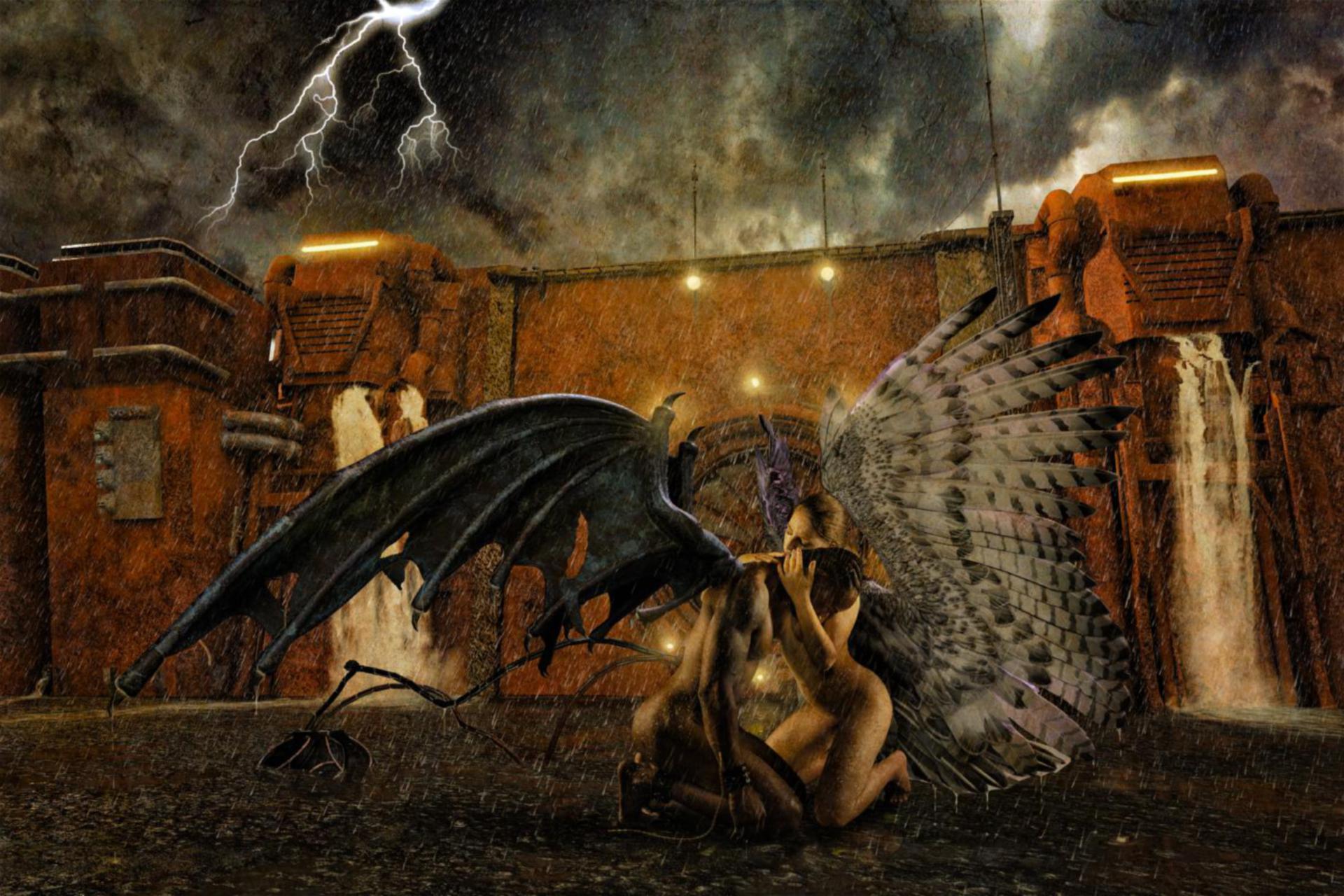
Before the menacing background of rust-red glowing industrial architecture, its flanks torn by roaring waterfalls and skies ripped apart by lightning, two fallen beings kneel.
To the left, the demonic angel – his body exhausted, the dark, leathery wings scarred with deep fissures. Delicate, wire-like strands connect him to an unknown apparatus, as though he were still ensnared in a world of pain and oppression. His gaze is lowered, his body bowed – a figure radiating suffering and weariness.
Opposite him, the bright angel with mighty, silver-feathered wings. Naked, vulnerable, and yet brimming with strength, she enfolds the fallen one, draws him close, rests his head upon her shoulder. In this gesture lies a quiet eroticism – not desiring, but protective, a surrender to the moment of closeness.
Here, light touches darkness without judgment. Skin color, wing shapes, origins – all this loses its meaning. What remains is pure tenderness, creating an oasis of humanity in the midst of chaos.
A work about solace, devotion, and the universal longing for touch – even, or especially, in the eye of the storm.
Inspiration: After a motif by Luis Royo
Sad Angels
Before the menacing background of rust-red glowing industrial architecture, its flanks torn by roaring waterfalls and skies ripped apart by lightning, two fallen beings kneel.
To the left, the demonic angel – his body exhausted, the dark, leathery wings scarred with deep fissures. Delicate, wire-like strands connect him to an unknown apparatus, as though he were still ensnared in a world of pain and oppression. His gaze is lowered, his body bowed – a figure radiating suffering and weariness.
Opposite him, the bright angel with mighty, silver-feathered wings. Naked, vulnerable, and yet brimming with strength, she enfolds the fallen one, draws him close, rests his head upon her shoulder. In this gesture lies a quiet eroticism – not desiring, but protective, a surrender to the moment of closeness.
Here, light touches darkness without judgment. Skin color, wing shapes, origins – all this loses its meaning. What remains is pure tenderness, creating an oasis of humanity in the midst of chaos.
A work about solace, devotion, and the universal longing for touch – even, or especially, in the eye of the storm.
 Sacrifice of an Angel
“For beauty is nothing but the beginning of terror,
which we are still just able to endure,
and we admire it so,
because it serenely disdains to destroy us.”
quote from Rainer Maria Rilke, Duino Elegies, First Elegy
Technique:
Photography, digital painting
A powerful staged tableau full of contradictions: vulnerability and strength, devotion and violence, spirituality and corporeality condense into an image-act of archaic resonance.
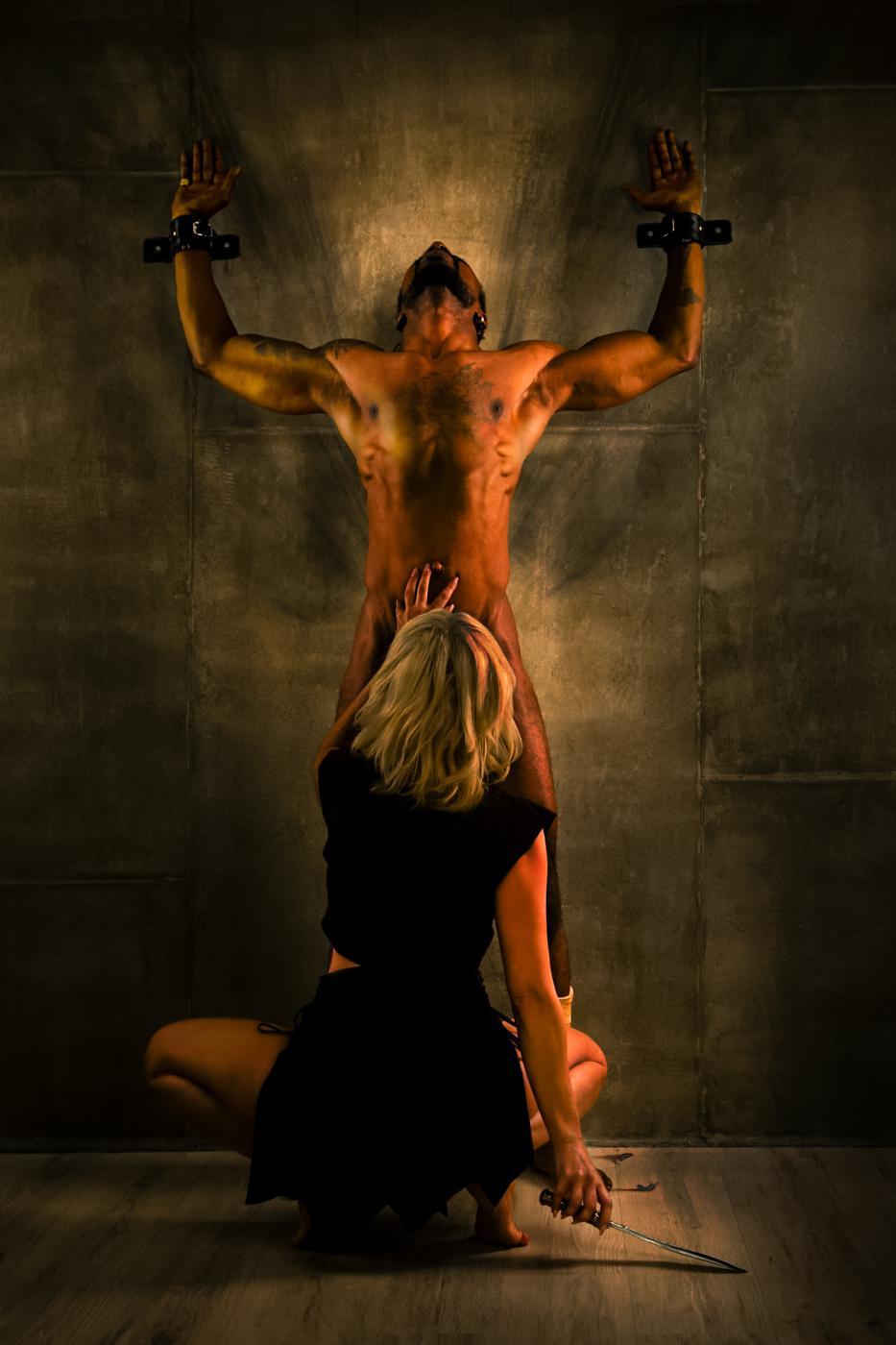
At its center stands a naked man, bound to the wall, arms spread wide – a pose oscillating between crucifixion, offering, and ecstatic surrender. Opposite him kneels a woman in dark robes, one hand upon his skin, the other clutching a dagger. Her posture shifts between priestess, lover, and executioner. The light sculpts both bodies as if they were statues of flesh and shadow, accentuating tension and touch, while casting the space as both sacred and foreboding.
A seemingly incidental detail at the lower edge of the image unfolds profound symbolism: two little dark feathers – delicate, almost overlooked. It refers to the title and anchors the work within a mythic sphere: Is the bound figure a fallen angel? A divine being in the instant of his final becoming-human? The feathers thus becomes a silent witness of transformation – a sign of lost wings, a trace of transcendent past.
“Sacrifice of an Angel” tells not only of pain and power, but also of spiritual decline, of a transformation inscribed in body, gesture, and gaze. The photograph compels the viewer to confront archetypal images: victim and priestess, angel and human, light and shadow.
What remains is the question:
A powerful staged tableau full of contradictions: vulnerability and strength, devotion and violence, spirituality and corporeality condense into an image-act of archaic resonance.
At its center stands a naked man, bound to the wall, arms spread wide – a pose oscillating between crucifixion, offering, and ecstatic surrender. Opposite him kneels a woman in dark robes, one hand upon his skin, the other clutching a dagger. Her posture shifts between priestess, lover, and executioner. The light sculpts both bodies as if they were statues of flesh and shadow, accentuating tension and touch, while casting the space as both sacred and foreboding.
A seemingly incidental detail at the lower edge of the image unfolds profound symbolism: two little dark feathers – delicate, almost overlooked. It refers to the title and anchors the work within a mythic sphere: Is the bound figure a fallen angel? A divine being in the instant of his final becoming-human? The feathers thus becomes a silent witness of transformation – a sign of lost wings, a trace of transcendent past.
“Sacrifice of an Angel” tells not only of pain and power, but also of spiritual decline, of a transformation inscribed in body, gesture, and gaze. The photograph compels the viewer to confront archetypal images: victim and priestess, angel and human, light and shadow.
What remains is the question:
Is this an act of destruction – or of redemption?
 Metatron und das Meer
"Immediately the Holy One, blessed be He, transformed me [...] He turned my body into a burning torch and all the sinews of my body into glowing fire."
— 3.Henoch, ch. 15
Technique:
Photography, composing, rendering, digital painting
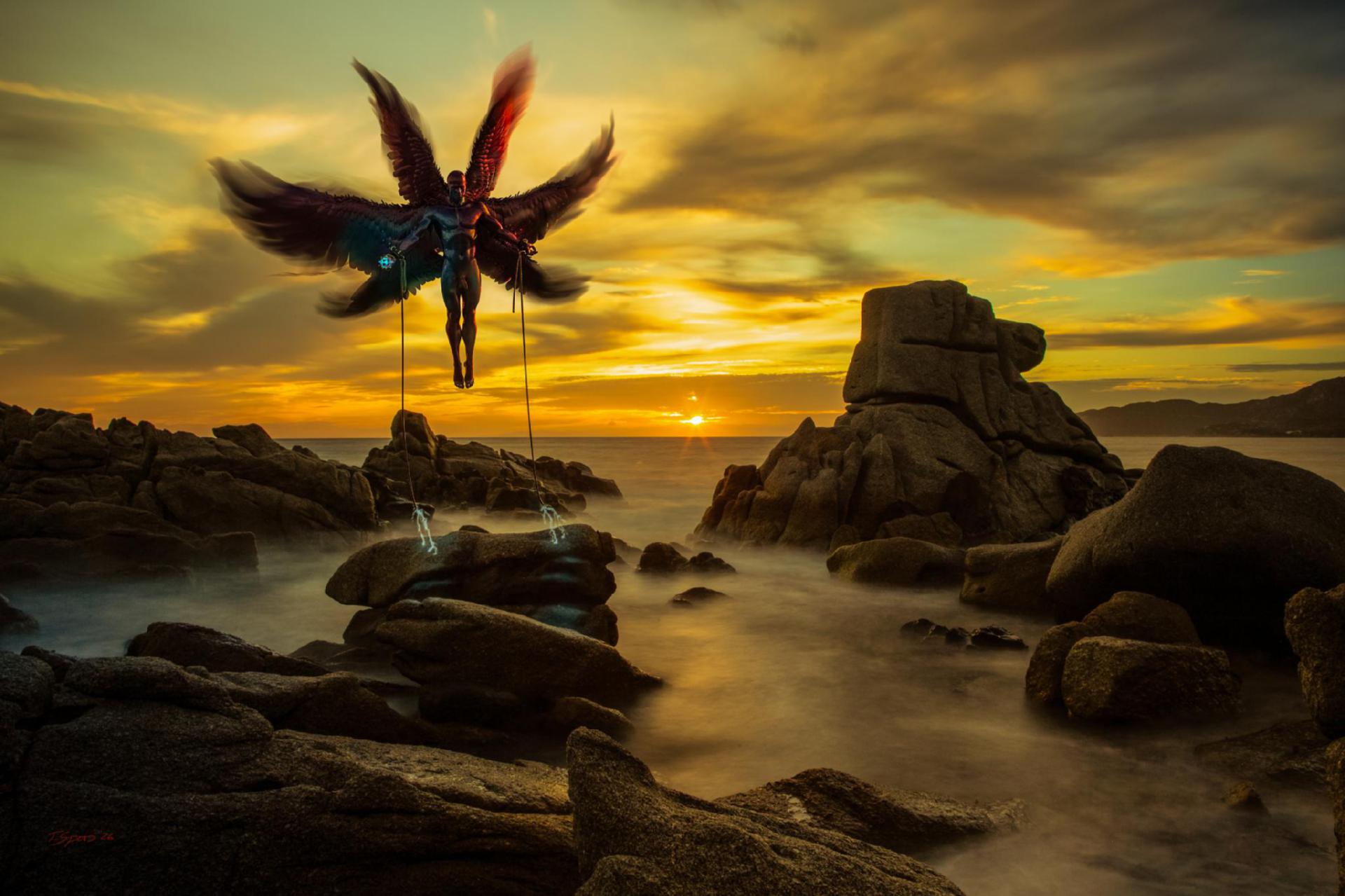
The artwork depicts the winged figure of Metatron, cradling a cube with an enclosed octahedron in his right hand, suspended above a rugged coastal landscape at the moment of sunset. Frayed ropes dangle from his wrists, reaching almost down to the crags. Energetic discharges hint at differences in potential.
Poised on the threshold between day and night, between matter and transcendence, the figure appears simultaneously detached and present—as though no longer bound to the physical realm. This state emanates from the geometric form in his right hand, infused with an alternative dimension of time and energy that flows downward to the discharge on the ground.
At the core of this interpretation lies the contrasting perception of time: while humanity exists within a state of constant acceleration, trapped in transience and the immediacy of the moment, Metatron dwells beyond this experience. For him, time appears stretched, permeable, or altogether suspended—a discrepancy profoundly mirrored in the landscape.
The rocks emerge with clarity, stillness, and immutability, embodying permanence, endurance, and time measured in geological epochs. In stark contrast, the sea is rendered soft and blurred, almost ethereal. Its movements unfold too rapidly for Metatron’s eye, operating as he does within different dimensions of time; consequently, the water loses its concrete form. The viewer is left only to sense the vast eons of erosion. Here, the fleeting nature of human existence becomes palpable: humanity, anchored firmly in the here and now, stands in opposition to Metatron, for whom anything changing too quickly eludes clear perception, dissolving into a mere passing impression.
Metatron hovers between these dual poles. In his right hand, he holds his cube, a symbol of sacred geometry—himself materialized in this very moment between the silent eternity of the stone and the fluid, intangible dynamics of the water. His wings remain visibly warped in time and space.
T.Spors (Edit 3)
The artwork depicts the winged figure of Metatron, cradling a cube with an enclosed octahedron in his right hand, suspended above a rugged coastal landscape at the moment of sunset. Frayed ropes dangle from his wrists, reaching almost down to the crags. Energetic discharges hint at differences in potential.
Poised on the threshold between day and night, between matter and transcendence, the figure appears simultaneously detached and present—as though no longer bound to the physical realm. This state emanates from the geometric form in his right hand, infused with an alternative dimension of time and energy that flows downward to the discharge on the ground.
At the core of this interpretation lies the contrasting perception of time: while humanity exists within a state of constant acceleration, trapped in transience and the immediacy of the moment, Metatron dwells beyond this experience. For him, time appears stretched, permeable, or altogether suspended—a discrepancy profoundly mirrored in the landscape.
The rocks emerge with clarity, stillness, and immutability, embodying permanence, endurance, and time measured in geological epochs. In stark contrast, the sea is rendered soft and blurred, almost ethereal. Its movements unfold too rapidly for Metatron’s eye, operating as he does within different dimensions of time; consequently, the water loses its concrete form. The viewer is left only to sense the vast eons of erosion. Here, the fleeting nature of human existence becomes palpable: humanity, anchored firmly in the here and now, stands in opposition to Metatron, for whom anything changing too quickly eludes clear perception, dissolving into a mere passing impression.
Metatron hovers between these dual poles. In his right hand, he holds his cube, a symbol of sacred geometry—himself materialized in this very moment between the silent eternity of the stone and the fluid, intangible dynamics of the water. His wings remain visibly warped in time and space.
T.Spors (Edit 3)
"When we meet the Shrike, we tell it what we want, one of us is granted the wish, and the others die."
Dan Simmons Quotes (Author of Hyperion) (page 15 of 37)
Technique: Computer Modelling (no AI)
Inspiration: Freely based on the novel Hyperion by Dan Simmons.
Note by T. Spors: (In the novel, the Shrike is described
as having four arms and is not depicted
as a biomechanical creature)
"Artist’s note: I highly recommend checking out Dan Simmons' two novels,
Hyperion and Endymion. They’re definitely some of the best
books I’ve ever read."
The Shrike – an artistic interpretation of the complex relationship between pilgrim and Shrike.
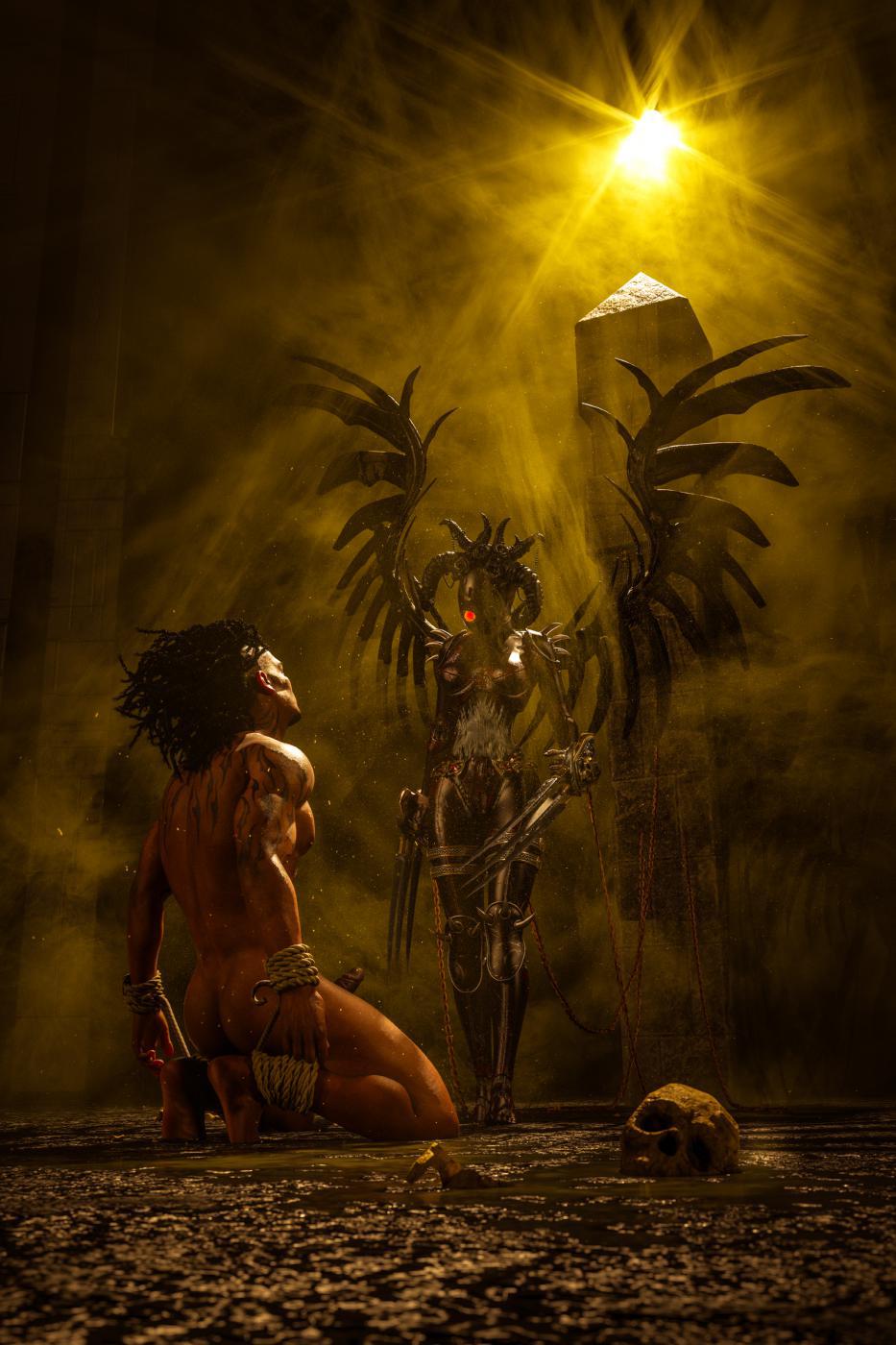
A dark, atmospheric scene depicts the ritualistic encounter between a pilgrim and the legendary creature from Dan Simmons' Hyperion Cantos. At the center of the composition, a human figure in primitive clothing kneels before the imposing stature of the Shrike – a posture of absolute devotion and submission.
The pilgrim, whose body language expresses both humility and a kind of ecstatic readiness, seems to voluntarily submit to the inescapable judgment of the biomechanical creature, despite being bound. This may serve as an allegory for the Last Judgment, where God (the light), in this case through the Shrike, judges the sinner.
Their position and gesture convey a paradoxical mixture of a death wish and spiritual fulfillment – that complex relationship between victim and destiny that permeates Simmons' work.The Shrike moves majestically among a few skeletal remains in front of a monumental pillar structure. Its metallic, thorn-covered limbs and glowing red eye radiate both a lethal threat and an allure that can only be described as erotic.
The scene is flooded by a dramatic beam of light, lending an almost sacred dimension to the ritualistic devotion. The warm, golden color palette heightens the ambivalent atmosphere – suspended between damnation and salvation, between the terror of death and the longing for a transcendent experience. This depiction captures the dark erotics of sacrifice, serving as a symbol for the vision of the human encounter with the Absolut.
Inspiration: Freely based on the novel Hyperion by Dan Simmons.
Note by T. Spors: (In the novel, the Shrike is described
as having four arms and is not depicted
as a biomechanical creature)
"Artist’s note: I highly recommend checking out Dan Simmons' two novels,
Hyperion and Endymion. They’re definitely some of the best
books I’ve ever read."
The Shrike – an artistic interpretation of the complex relationship between pilgrim and Shrike.
A dark, atmospheric scene depicts the ritualistic encounter between a pilgrim and the legendary creature from Dan Simmons' Hyperion Cantos. At the center of the composition, a human figure in primitive clothing kneels before the imposing stature of the Shrike – a posture of absolute devotion and submission.
The pilgrim, whose body language expresses both humility and a kind of ecstatic readiness, seems to voluntarily submit to the inescapable judgment of the biomechanical creature, despite being bound. This may serve as an allegory for the Last Judgment, where God (the light), in this case through the Shrike, judges the sinner.
Their position and gesture convey a paradoxical mixture of a death wish and spiritual fulfillment – that complex relationship between victim and destiny that permeates Simmons' work.The Shrike moves majestically among a few skeletal remains in front of a monumental pillar structure. Its metallic, thorn-covered limbs and glowing red eye radiate both a lethal threat and an allure that can only be described as erotic.
The scene is flooded by a dramatic beam of light, lending an almost sacred dimension to the ritualistic devotion. The warm, golden color palette heightens the ambivalent atmosphere – suspended between damnation and salvation, between the terror of death and the longing for a transcendent experience. This depiction captures the dark erotics of sacrifice, serving as a symbol for the vision of the human encounter with the Absolut.
More info:


Portfolio Insta
Social Media and more
Portfolio Insta